 Skip to content



Major storms don’t care how old the grid is or how prepared a community feels. When Hurricane Irene hit in 2011 and a derecho followed a year later, Dominion Energy saw firsthand what overhead wires can’t withstand: falling trees, ice, wind, and unpredictable weather. Those storms knocked out power to nearly a million customers — a wake-up call that led Dominion to launch one of the nation’s largest and most successful undergrounding initiatives.
Their Strategic Underground Program (SUP) has now buried nearly 2,000 miles of their most outage-prone power lines. And the results are clear: undergrounding dramatically reduces storm-related outages, shortens restoration times, improves safety, and enhances community aesthetics.
But there’s a second half to this story — and it’s where the damage-prevention industry, including Trident Solutions, plays a critical role:
Once utilities are buried, they must be marked, tracked, located, and protected from excavator damage.
The work doesn’t end when the line goes underground. In many ways, it’s just beginning.
Why Undergrounding Works — And Why Visibility Still Matters
Dominion learned that not all overhead lines need to be buried. Roughly 20% of their tap lines caused two-thirds of outage events, so they targeted the highest-risk circuits first. That’s smart, data-driven engineering.
But Dominion also learned a second truth: once you bury infrastructure, public awareness drops. Homeowners can see a downed pole — but they cannot see an energized electric line buried 18 inches under their lawn.
That’s where above-ground safety markers, tracer wire systems, warning tape, and advanced asset-tracking technologies come into play.
Undergrounding reduces storm damage, but damage from digging becomes the new threat.
1. Public Awareness: Above-Ground Markers Protect What You Can’t See
When neighborhoods shift to underground utilities, surface-level visibility becomes essential. That’s why utility operators rely on:
These aren’t decorations, they are regulated safety devices designed to:
- Warn homeowners before digging
- Identify what utility lies beneath
- Provide color-coded clarity (811 standards)
- Survive weather, lawn equipment, and UV exposure
As more communities embrace undergrounding, reliable markers become the first line of defense for buried assets.
2. Locating Underground Lines
Utility locators receive the brunt of the blame from the damage prevention world. They work long hours under tight deadlines and face the increasingly high demand for utility locates. Private utility locate companies battling nationwide staffing issues only compound the stress.
Fortunately, there are innovative tools that can assist locators in performing their duties with increased accuracy and efficiency.
- Tracer Wire: One best practice is installing a tracer wire directly above telecommunications lines when they are installed. This tracer wire system should be corrosion, moisture, chemical, oil, impact, crush, and abrasion resistant. Many organizations already include the use of tracer wire in their specifications, and more states are pushing to legally require all underground utilities to install tracer wire with their assets.
However, not all tracer wire is created equal. Use of an extra high-strength copper clad steel (CCS) wire is typically preferred. CCS wire is not only cheaper, but also stronger than standard copper wire. It can provide locators a more accurate read on the location and depth of a company’s buried assets.
- Test Stations: Often, tracer wire is poorly maintained or exposed to the elements. An aboveground test station can protect both the tracer wire and access terminals from severe weather and vandalism.
Flush mounted test stations can be mowed over while still providing a visible warning, and they’re ideal for areas where aboveground test stations are not practical. It has a telescoping terminal board for quick access to the tracer wire. An added benefit of test stations is they provide a visible warning message about the presence of the facility 365 days a year.
- Hardware: Locating multiple utility lines can become a tedious task for the locator—having to locate lines separately and continuously reconnect to the different terminals significantly slows down their process.
Today, hardware exists that can be added onto a test station that enables the locator to “shunt” the connection and connect to all the facilities at once. Shunting or jumping each one of the laterals with the ground allows the locator to connect to the ground as well as any one of the four terminals that go to the laterals.
- Ground: Grounding anodes should be installed at all dead ends of the tracer wire system to complete the electrical circuit needed to enhance signal for locating purposes. Grounded tracer wire allows the locator to use a lower frequency which provides the most accurate results for locating. Using a higher frequency tends to bleed-over into other buried utilities, making the locate inaccurate.
The best way to ground a tracer wire system is to install a 1.5-pound drive-in magnesium ground rod and an access point at each tracer wire dead end. An access point will protect the wire and provide a direct connection point for a utility locate transmitter to connect to the tracer wire. It also provides a connection point for the ground rod wire and allows the ground connection to be turned on and off, allowing you to control the signal on the target line.
- Connectors: A tracer wire system is only as good as its weakest connection. It is vital to use connectors that are water and corrosion-proof to protect vulnerable wire splices and keep the locate signal flowing across connections.
3. Protection from Excavator Error: Buried Warning Tape
Dominion’s program reduces outages from storms — but the Common Ground Alliance still reports that excavation damage is the #1 root cause of utility strikes year after year.
A storm may cause outages once or twice a year.
Excavators dig every single day.
Trident’s underground warning tape adds critical redundancy:
- Serves as a last-chance physical warning
- Provides visual alerts for excavators
- Is available in standard 811 colors
- Can include custom print, logos, or messagin
Combine that with tracer wire, warning tape, and above-ground markers, and Trident offers one of the industry’s most complete underground asset-protection ecosystems.
In Conclusion …
Dominion Energy’s program proves a critical point:
Undergrounding utilities dramatically reduces storm-related outages — but buried assets must still be marked, located, and protected.
As more municipalities, co-ops, and utilities move infrastructure below the surface, the next step is making sure those lines stay safe for decades.
Trident Solutions provides:
- Above-ground utility markers & signage
- High-visibility durable decals
- Buried warning tape (detectable & non-detectable)
- Tracer wire, connectors & HDD-compatible materials
- RFID-enabled tags for asset tracking
- Complete safety marking solutions for underground utilities
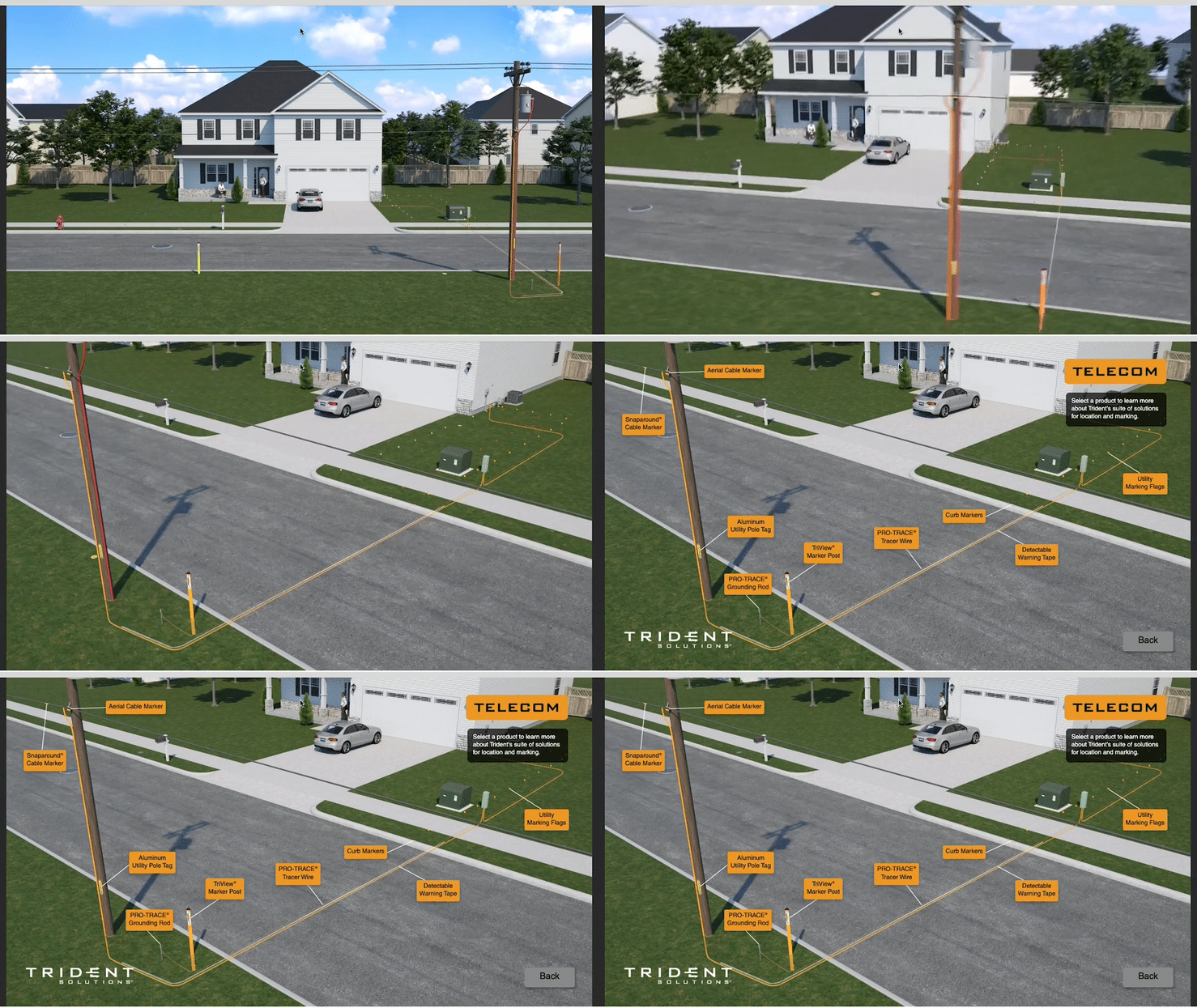
Check out our Interactive Product Hub to see how all of our products can work together to create a “Complete Damage Prevention System”