 Skip to content


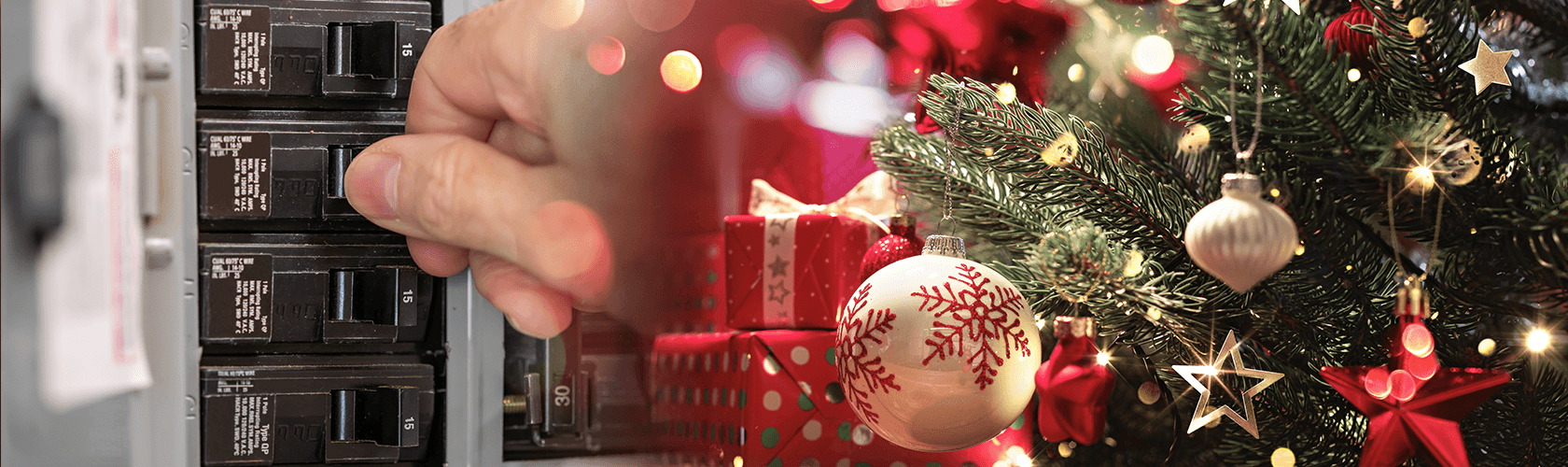
It takes a lot to power the holidays!
The U.S. Energy Information Administration reports that residential electricity use jumps roughly 23% in December compared to June. Holiday lights alone consume an estimated 6.6 billion kWh of electricity nationwide, which is enough to power 800,000 homes for a full year!
Higher power demand also means increased likelihood of error. Each year, the National Fire Protection Association reports:
- An average of 830 home fires that began with Christmas decorations
- Candles cause 20% of December home fires
- Electrical distribution issues account for 43% of Christmas tree fires
Home Electrical Distribution 101
I once had a coworker temporarily knock out power for half of our office because he had TWO space heaters plugged into one power strip. In his defense, he was not from Minnesota and adjusting to the winter temperatures here can be difficult, if not soul-crushing at times.
My former coworker is just a good example of how most people (myself included) plug things in without ever thinking about how much power their circuits can safely handle.
I realized that I myself could use a little tutorial on understanding circuit limits in order to best to avoid tripped breakers, shorts, or and potential electrical fires.
Here are the easiest ways to figure it out:
1. Check Your Breaker Panel (the Main Source of Truth)
Every circuit in your home is controlled by a breaker labeled with a number — 15, 20, sometimes 30 amps.
How to calculate capacity: Watts = Volts x Amps
However, there is an electrical safety guideline called the “80% rule”, where a circuit should only be loaded to 80% of its maximum rated capacity for any continuous use. Standard outlets in U.S. households provide 120 volts, so the updated formula is:
Amps × 120 volts × 0.8 = Safe wattage limit
- 15-amp circuit → can handle roughly 1,440 watts (15 x 120 x 0.8)
- 20-amp circuit → can handle roughly 1,920 watts (20 × 120 × 0.8)
If you plug a 1,500-watt space heater into a 15-amp circuit, you’re already exceeding the safe limit (1,440 watts). Add lights, a TV, or a coffee maker to the same circuit and the breaker will almost certainly trip.
2. Look at the Outlet Type
Most outlets don’t list wattage, but the shape can give clues:
• Standard 15-amp outlets Two vertical slits + ground. These are the most common.
• 20-amp outlets One vertical slit, one T-shaped slot + ground. If you see a T-slot, that outlet (and usually the circuit) is 20 amps.

3. Add Up the Wattage of Devices You’re Plugging In
Everything you plug in has a wattage rating, usually printed on the tag or power brick.
Common holiday items:
- LED String Lights: 5–20W per strand
- Incandescent String Lights: 40–300W per strand
- Inflatable Decorations: 60–250W each
- Space Heaters (warning!): 1,500W
- Crockpots, electric griddles, etc.: 200–1,500W
If the total wattage exceeds your circuit limit, you’re asking for a trip… or worse.
4. Know Which Outlets Share the Same Circuit
Not every outlet has its own breaker and sometimes an entire room, or even multiple rooms, will be on the same circuit.
To find out:
- Turn off one breaker.
- Walk around and see which outlets/appliances lost power.
- Label them! Avoid having to repeat this process in the future.
5. Use a Circuit Load Tester (They’re Cheap)
A load tester (or circuit analyzer) plugs into the outlet and tells you if the circuit is overloaded, under-voltage, or improperly wired.
You can easily find them at a Home Depot or other hardware store, and they’re great for peace of mind during the holidays.
They could be the perfect stocking stuffer for the new homeowner on your shopping list.
6. When in Doubt, Use the “One Heavy Appliance Per Circuit” Rule
As reference from my anecdote above, microwaves, space heaters, hair dryers, air fryers, and electric griddles all use a ton of wattage. If you plug more than one of these into the same circuit, you’re pretty much begging for a circuit trip.
Quick Safety Tips
- Avoid daisy-chaining power strips (plugging one power strip into another)
- Use outdoor-rated extension cords for any outside decorations.
- Keep cords away from snow/standing water.
- If outlets feel warm, unplug something immediately.
