 Skip to content



Adopting new technology for your business is no small decision, and there are many routes one can take.
Some organizations are willing to experiment, take a few calculated risks, and figure things out before everyone else. Others often wait until the technology is so widely adopted that they practically have no choice. When it comes to Radio Frequency Identification (RFID), that second group might be making a very expensive mistake.
At Trident, we’ve been investing heavily in RFID technology, and our latest addition is a proprietary 5-in-1 machine designed to bring together advanced production capabilities, high capacity, and quality control. It’s an impressive piece of equipment, and we put together a quick 30-second video to show it off.
For those who may need a quick lesson on RFID, here’s a brief comparison of how RFID scanning works versus traditional barcodes.
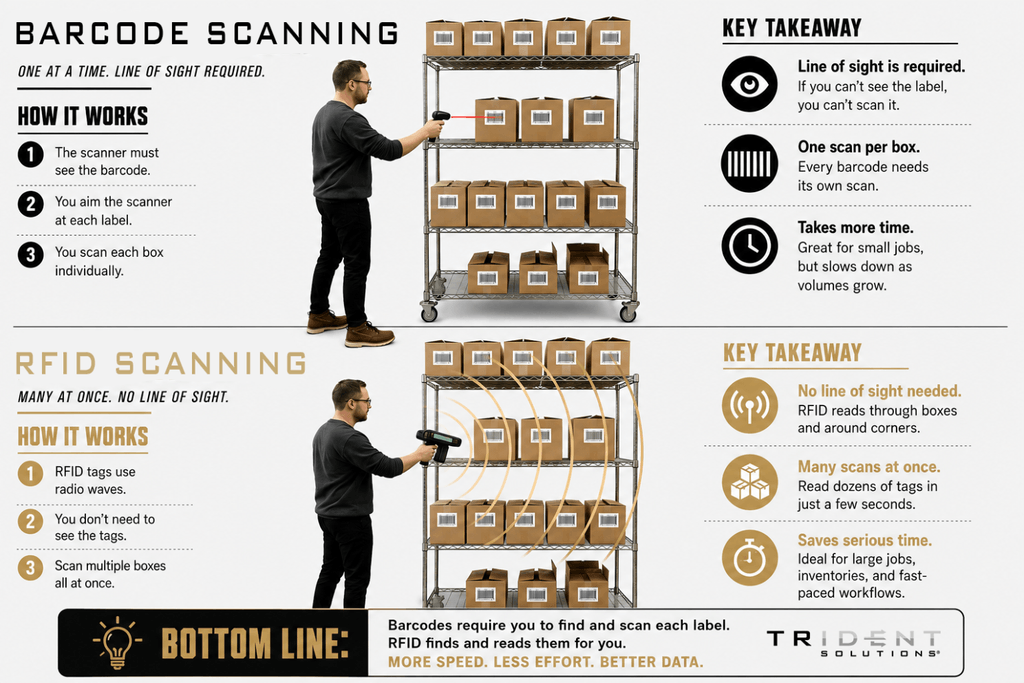
But here’s the bigger question: Why are we investing in this technology?
Because RFID is already delivering some remarkable results, and the opportunity is only getting bigger. Here are five examples that should get the attention of anyone responsible for inventory, warehousing, or distribution.
1. Inventory Counts: 5 Times Faster
Imagine completing a five-hour inventory count in one hour.
Sporting goods giant Decathlon reported that RFID made its inventory operations five times more efficient.
Instead of individually scanning barcodes, employees can identify multiple RFID-tagged products in seconds.
Less counting. Less labor. More time doing something productive.
Source: GS1 US — Decathlon RFID Case Study
And if you don’t want to just take the case study’s word for it, watch our own rudimentary time trial we did:
2. Shipping Errors: Down Nearly 70%
Shipping the wrong product isn’t just embarrassing. It’s expensive.
There’s the cost of correcting the mistake, additional handling, customer service, and potentially an unhappy customer. UPS reported that its RFID technology has reduced package misloads by nearly 70%.
For an operation handling hundreds thousands of shipments daily, that’s almost an incomprehensible figure!
Source: UPS — Lighting Up Our U.S. Network End-to-End with RFID (2026)
3. Barcode Scanning: 26 Times Slower
Brooks Running implemented RFID technology at its primary U.S. distribution center to improve shipping accuracy.
The result? Its RFID scanning process was 26 times faster than manual barcode scanning, according to the company’s technology partner.
Brooks also reported improved shipping accuracy and fewer costly chargebacks. If you’re managing a distribution center, it’s worth asking how much time your employees spend scanning products one at a time.
Want even more proof? No problem! Here’s another time trial we did where RFID was 10x faster than barcode.
4. Inventory Labor: A Dramatic Reduction
Zara used to require 40 employees working five hours to complete a storewide inventory.
After implementing RFID, just 10 employees could complete the same process in half the time.
That’s a reduction from 200 labor-hours to 25.
And remember, that’s just one inventory count at one location.
Now imagine the implications across an entire network.
Source: Impinj — Zara’s Retail Inventory Management System
5. Inventory Waste: $14 Million in Annual Savings
RFID isn’t limited to retail or traditional warehouses.
Texas Children’s Hospital implemented RFID-enabled inventory management to track medications, monitor expiration dates, and reduce waste.
According to its technology provider, the hospital reported $14 million less in spending on clotting factor medications compared with the previous year.
Different industry. Same fundamental challenge: knowing exactly what you have, where it is, and when you need it.
Source: Zebra Technologies — Texas Children’s Hospital RFID Case Study
So, Where Are We on the Adoption Curve?
Everett Rogers developed the “Diffusion of Innovations Theory”, which describes how new technologies spread through society.
It starts with innovators, moves to early adopters, and eventually reaches the early majority, late majority, and laggards.
In competitive professional landscapes, its imperative to be on the front half of the curve.
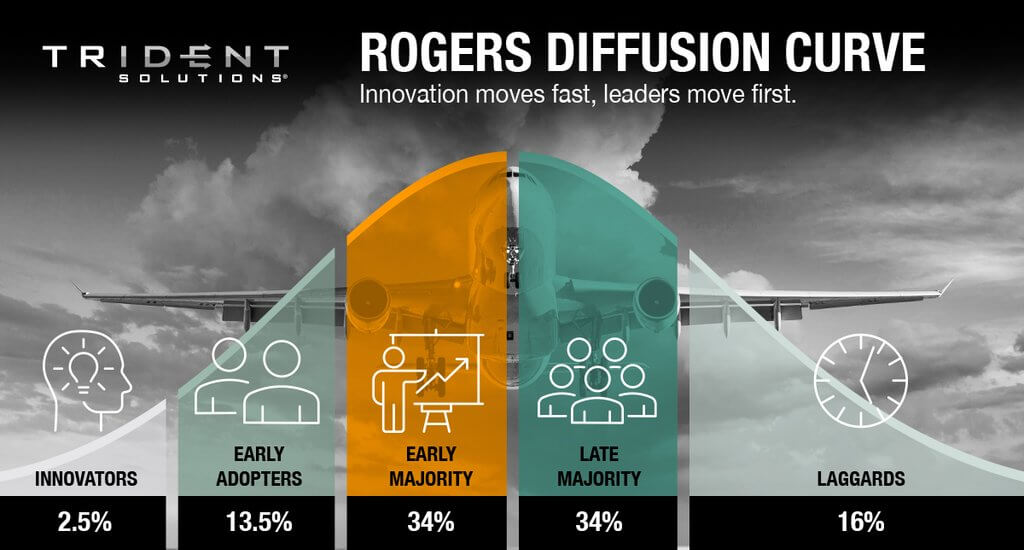
RFID is already well established in some industries, while others are still discovering its potential.
The RAIN Alliance reported 42.7 billion RFID tag chips shipped globally in 2025. This isn’t some distant technology waiting to become practical.
It’s happening now.
And that’s why we’re investing in the manufacturing technology and capacity to help organizations take advantage of it.
The question isn’t whether RFID can save businesses money. The examples above have already answered that.
The question is whether you’ll take advantage of the opportunity before your competition does.
Innovation moves fast. Leaders move first.
Interested in exploring what RFID could do for your operation? Connect with the RFID team at Trident Solutions.